
Written by the Rock Limo Service team
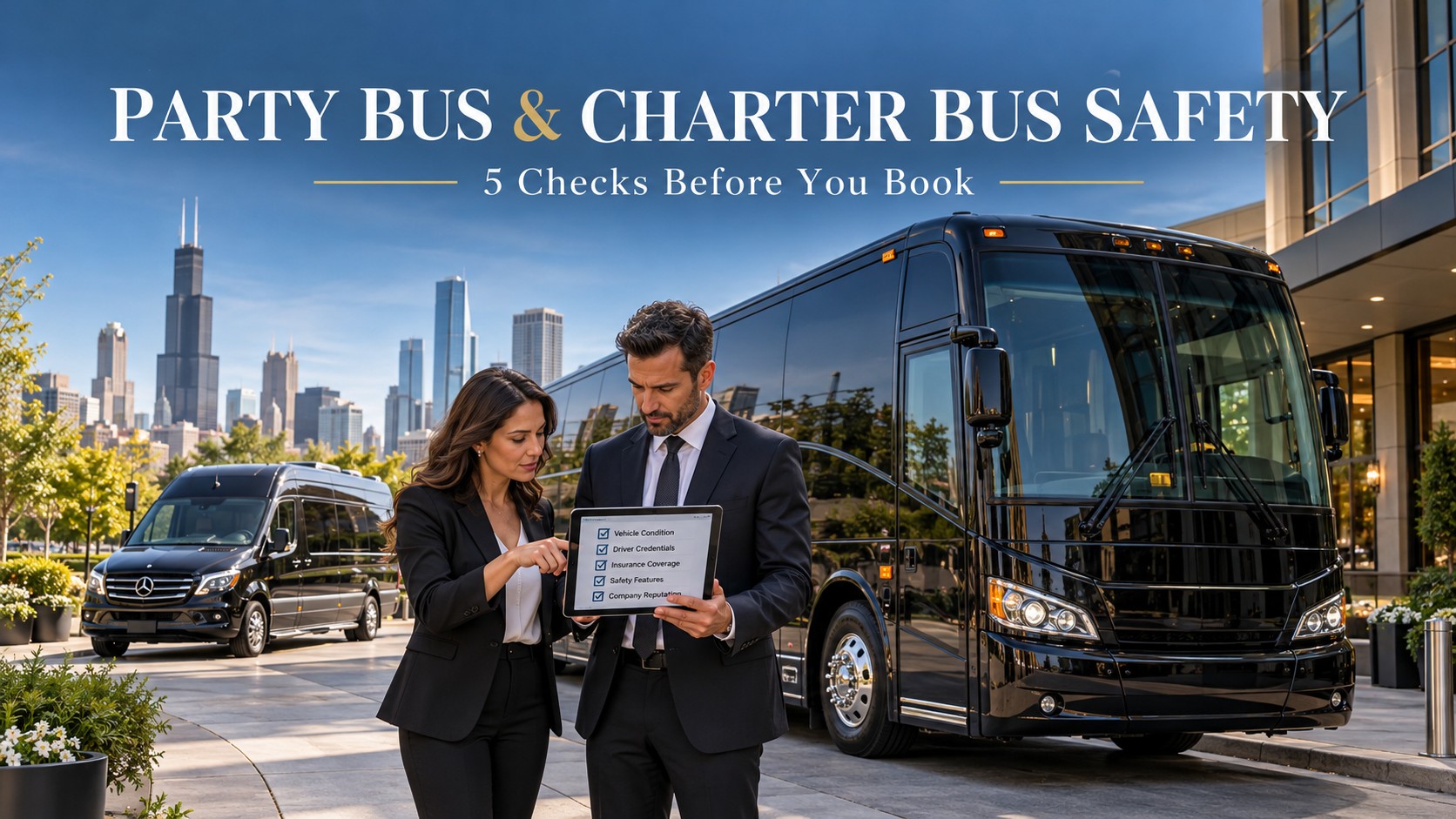
A party bus safety check should happen before a group pays for a reservation, not when everyone arrives at the pickup point. Whether you are arranging a birthday celebration, prom night, corporate outing, wedding shuttle, or charter coach trip, the important questions concern the actual transportation operator, the specific vehicle, the driver, and the written reservation. Customers researching Chicago limo service should be able to ask these questions comfortably and receive clear answers without pressure.
A luxurious photograph and an attractive quote cannot establish whether a bus company is qualified to operate a particular trip. This party bus safety check focuses on information a customer can reasonably verify. A booking company may arrange service through another licensed carrier, and the vehicle shown online may represent a category rather than the exact bus assigned. That is not automatically a problem. What matters is transparency about who will provide the service and which details have been confirmed.
This guide explains five practical checks Chicago-area families, schools, businesses, and event organizers can make. It also shows how to read publicly available federal records when those records apply, recognize concerning booking practices, and organize the information needed for a clear quote.
Quick Answer: Before booking a party bus or charter coach, identify the actual operating carrier, verify its applicable authority and available safety information, request appropriate insurance confirmation, check the exact vehicle and legal passenger capacity, and review the complete written reservation terms. Federal records are useful for carriers within federal jurisdiction, but not every local vehicle or trip has the same requirements. A missing federal safety rating is not, by itself, proof that a company is unsafe. Ask questions until you understand who is operating your trip.
Why a Party Bus Safety Check Begins With the Operating Carrier
The first question is not which bus has the most impressive interior. It is who will actually transport the passengers. The name on a website, the company that accepts an inquiry, the name on a contract, and the legal motor carrier operating a bus are not necessarily identical. Transportation coordinators may use an affiliate network to match an itinerary with a suitable licensed provider.
That arrangement can give customers more vehicle options, but it also means a reservation deserves an extra identity check. Ask the booking team for the full legal name of the operating carrier assigned to the trip. Request any applicable registration identifiers, and confirm who is responsible for dispatch, driver assignment, and service on the travel date.
Rock Limo LLC explains its coordination model on its About Rock Limo page. Depending on the trip, service may be coordinated through licensed transportation affiliates rather than a vehicle owned directly by Rock Limo. Customers should receive clear information about the assigned operator, vehicle specifications, and final terms before confirming service.
Affiliates are not inherently safer or less safe than direct operators. Evaluate the carrier performing the trip, because its vehicle, personnel, and applicable records are what matter.
Check 1: Establish who will drive the bus
Ask for the operating carrier’s legal business name and the name under which it does business if different. For federally regulated motor carriers, the U.S. Department of Transportation number can help identify the correct record. Depending on the service and jurisdiction, additional operating authority or state and local credentials may apply.
If the provider cannot identify the actual operator yet because the vehicle assignment is pending, ask when that information will be supplied. Do not treat a preliminary vehicle-category quote as proof that a particular operating company or vehicle has been secured. A written confirmation should resolve that uncertainty before the reservation is finalized.
Party Bus Safety Check: How to Read Federal Records
The Federal Motor Carrier Safety Administration, known as FMCSA, provides public tools for reviewing many federally regulated commercial passenger carriers. Its SAFER Company Snapshot system can be searched by company name, USDOT number, or other applicable identifier. It may show company identity, operating information, inspection summaries, crash data, and a federal safety rating when one has been assigned.
That information is a useful screening resource, but it needs interpretation. Federal requirements depend on factors including the kind of operation, vehicle, passenger service, and whether transportation is conducted in interstate commerce. A local trip cannot automatically be judged by the same registration rule as every interstate motor coach. State and local transportation requirements can also apply.
For that reason, avoid simplistic claims that every party bus must possess the same federal registration solely because of its advertised seating capacity. If a company says it operates only under state or local authority, ask it to explain which rules apply and provide the appropriate documentation. When a trip crosses state lines, the organizer should confirm that the operating carrier is authorized for that service.
Check 2: Match the correct record to the correct company
Start with the legal operating-carrier name and identifier supplied by the provider. Open the FMCSA Company Snapshot through the agency’s official SAFER system. Compare the carrier’s identifying information with what you received, and look for relevant status or history information. When unsure how to interpret a field, use FMCSA’s own explanations instead of a third-party summary.
One important distinction: not rated does not mean rated unsafe. Some carriers do not have a federal safety rating on record. Inspection and crash histories also require context; a raw number does not independently reveal the condition of a particular vehicle today. An apparently clean public record cannot guarantee that a future trip will be incident-free.
If the name in the federal record does not match the operator named in your reservation, seek clarification before proceeding. The booking company might be a coordinator, or the operator’s trade name might differ from its legal registration. Both situations can be legitimate, but they should be explainable and documented.
The same principle applies to charter service. A provider offering Chicago charter bus service for schools, corporate teams, tours, and regional travel should be able to discuss the carrier assigned to that journey and help an organizer obtain the information needed for verification.
Verify Insurance, Driver Qualifications, and Trip Suitability
Registration information does not prove appropriate insurance coverage. Requirements vary with the service and vehicle; ask for documentation relevant to the proposed trip rather than assuming a general business policy covers it.
A certificate of insurance may help confirm named entities, policy periods, and coverage information, but it should not be treated as a guarantee that every contractual or legal requirement has been satisfied. Schools and corporate procurement departments may have additional requirements and may need documentation reviewed by their own risk-management teams.
Check 3: Request relevant documents and driver assurances
Ask the operating carrier or coordinating reservation team how licensing and insurance requirements for the trip are confirmed. For a large coach or other commercial passenger vehicle, ask whether the assigned driver holds the license and endorsements required for that vehicle and operation. The provider should also understand applicable driving-time and rest requirements without promising an unrealistic nonstop schedule.
Organizers do not need to collect private driver records or sensitive personal documents. They do need reasonable assurance that the operating company will assign appropriately qualified personnel and operate within the law. A professional provider should be able to explain its process and address legitimate questions about permits, accessibility, and long-duration trips.
For an event requiring several pickups or coordinated arrivals, the Chicago group transportation coordination service is relevant because the organizer must plan each leg, passenger group, vehicle, and operating partner rather than treating the trip as one simple transfer.
Ask about accessibility before committing
If passengers require a lift-equipped vehicle, assistance with boarding, space for mobility devices, or other accessibility arrangements, disclose the requirements before the quote is finalized. Never assume that a photograph of a motor coach establishes what accessibility equipment it offers. Confirm suitable equipment, boarding arrangements, and service responsibilities for the exact vehicle.
For school trips, youth groups, or organizations with formal safety policies, identify the person authorized to approve transportation and clarify chaperone responsibilities. A responsible itinerary includes emergency contacts and a plan for communicating a schedule change, not merely the venue address.
Inspect the Exact Vehicle and Its Legal Passenger Capacity
Next, examine the bus itself. Photographs help compare categories but cannot confirm the model, seating layout, legal capacity, or features assigned to a particular trip.
Rock Limo’s vehicle fleet information states that its displayed vehicles represent categories available for request through its coordination network. Exact models, legal capacities, interiors, operating carriers, and amenities must be confirmed for the reservation. That distinction protects customers from making plans around a representative image that differs from the eventual assignment.
Check 4: Confirm capacity beyond the headline number
Begin with the final count of everyone who will travel, including any adults supervising minors. Then list luggage, sports bags, instruments, equipment, coolers, mobility devices, or other bulky items. A vehicle’s maximum legal passenger capacity is not necessarily the practical number for a group carrying extensive belongings. Emergency exits, doors, and aisles must remain clear.
The company’s group vehicle capacity guide discusses the available categories and the difference between seating and luggage room. Use that guide for size comparisons, then obtain written confirmation of the particular vehicle assigned. Never decide solely from an advertised maximum capacity or assume that a larger passenger number means a better fit.
A Sprinter party bus or executive van can be worth considering for a smaller group, but interiors vary. A celebration-oriented cabin and an executive shuttle layout may serve different purposes. Ask about actual seating, climate control, storage, entry, and accessibility before selecting the category.
For a medium-size outing, the 22-passenger party bus option may be relevant. Larger social groups can review the 38-passenger party bus category. Those are descriptions of available categories, not promises that every bus, interior, and date will be available.
Longer trips or larger groups may call for a coach. Compare the 40-passenger motor coach and 56-passenger motor coach options with attention to luggage compartments, seating needs, trip length, and the operating carrier’s confirmation.
What to request in writing
Ask for the confirmed vehicle category and legal passenger capacity, current photographs when available, accessible features if required, luggage limitations, and any amenities that matter to the group. If a specific model or interior is essential, make that expectation part of the written discussion rather than relying on an advertisement.
A vehicle substitution may sometimes be necessary. Clarify the substitution policy before paying, including how a replacement would meet agreed passenger capacity, equipment needs, and accessibility requirements. A substitute should never be assumed acceptable simply because it has the same broad category name.
Review the Entire Reservation, Not Just the Quoted Price
A low advertised price cannot make an unclear reservation safe or reliable. Group organizers should understand the complete itinerary, duration, payment obligations, cancellation rules, possible vehicle substitutions, and what happens if a schedule changes. Written terms help prevent disputes, especially when passengers are coordinating several stops or returning after an event.
Check 5: Obtain a clear written agreement
Request a quote identifying the date, pickup and destination addresses, planned stops, expected return, passenger count, and requested vehicle type. Ask which operator is assigned or when that information will be confirmed. Review the total price and any additional charges related to waiting, overtime, cleaning, parking, tolls, itinerary changes, or other stated conditions.
Rock Limo publishes a Chicago limo and party bus pricing guide that explains its published price categories and factors affecting quotes. Since a particular quote depends on the real itinerary and available carrier, a public rate listing is not a substitute for a final written offer.
The company’s booking policies guide provides a separate starting point for understanding waiting, gratuity, cancellation, and changes. Read the terms that apply to your own reservation rather than assuming that a previous customer’s agreement or a general summary governs every trip.
When using a quote-request system, distinguish submitting an inquiry from completing a booking. Rock Limo’s current online process says a quote request enters its Moovs system for review; submitting that request alone does not confirm a vehicle or reservation. Confirm the final acceptance steps and retain the written confirmation for the organizer.
How to Spot Warning Signs Without Making Unfair Assumptions
A sensible screening process looks for specific gaps rather than making accusations based on a website’s appearance. Not every small operator has an elaborate website. Not every missing online review indicates a problem. What matters is whether the provider can explain its operations and supply documentation appropriate to the trip.
Be cautious when a company will not identify who is operating the vehicle, advertises a capacity without discussing legal seating, refuses reasonable questions about credentials, or pressures the group to pay before presenting clear terms. Contradictory company names and evasive answers about the actual bus also deserve follow-up.
Be wary of unrealistic schedules that ignore boarding, venue access, traffic, stops, or driver requirements. Ask for a revised plan if the proposed itinerary seems impractical.
There can be innocent explanations for administrative differences. A business may use an established trade name, book through a coordinator, or assign a licensed affiliate. The solution is to request an accurate explanation and confirm the documents rather than assuming misconduct.
A party bus safety check is a decision-making tool. It reduces avoidable uncertainty, but it does not eliminate every transportation risk.
Extra Questions for Proms, Schools, Weddings, and Corporate Groups
The five core checks apply broadly, but the trip’s purpose determines which additional questions matter. A prom group involving minors requires different supervision from a corporate conference. A wedding has strict ceremony times. A school field trip may have written procurement or chaperone requirements. The route and passenger needs should guide the final discussion.
Prom and homecoming groups
Parents should approve the route, passenger list, designated contact, scheduled stops, and end-of-night pickup plan. Ask about the operator’s policies concerning alcohol, vaping, unapproved stops, and passenger behavior. Do not infer rules from party-bus marketing photographs. The prom and homecoming party bus planning guide offers additional trip-specific considerations without replacing the operator verification process.
Weddings and multi-vehicle itineraries
Wedding organizers should identify who controls the schedule when photos, ceremonies, dinner service, and guest returns overlap. A bus can be fully qualified yet still be unsuitable for a narrow arrival window or a venue that cannot accommodate its size. Verify loading areas and accessibility with the event venue, and ensure the transportation operator knows which deadlines are fixed.
Corporate groups and school travel
A company arranging employee transport may need procurement documentation, billing details, insurance verification, and a named coordinator for each leg. Schools may need permission forms, chaperone assignments, and review under their own transportation policies. Organizations should not substitute a general online checklist for their legal, insurance, or institutional obligations.
If the group’s travel includes overnight segments or state lines, discuss driver scheduling and carrier authority early. Waiting until the week of departure can narrow the available vehicle and operator options.
A Printable Party Bus Safety Check for Organizers
Use this checklist before approving a group booking. Keep the answers with the itinerary so another organizer can review them without restarting the entire process.
We know the legal identity of the operating carrier, not only the booking brand.
We have checked applicable registration or operating authority information.
We understand whether federal, state, or local requirements apply to this trip.
We have reviewed available official safety information without confusing an unrated carrier with an unsafe rating.
We have requested appropriate insurance and driver-qualification assurances.
The exact vehicle or acceptable category is documented in the reservation.
Passenger capacity, luggage, and accessibility requirements are confirmed.
Our itinerary includes all stops, timing, return travel, and contact persons.
The written quote identifies payment, cancellation, waiting, and substitution terms.
We understand how a quote becomes a confirmed reservation.
If an answer remains unclear, request clarification. Obtain relevant information rather than demanding documents that do not apply to the trip.
Frequently Asked Questions
How can I confirm the company actually operating my party bus?
Ask the booking provider for the operating carrier’s full legal name and applicable registration information. The carrier operating the trip may differ from the company coordinating the booking. Confirm the relationship and retain the details with your reservation.
Where can I check a charter bus company’s federal safety record?
FMCSA’s official SAFER Company Snapshot provides publicly available information for carriers in its system. Search using the correct legal name or identifier and interpret the results alongside the type of operation and available agency guidance.
What does a missing FMCSA safety rating mean?
It means a federal safety rating is not displayed for that company in the record checked. It does not, by itself, establish that the carrier is safe or unsafe. Ask appropriate follow-up questions and review other relevant records.
Do all Chicago party buses follow the same federal registration rules?
Requirements depend on the actual commercial operation, vehicle, and jurisdiction. Interstate services and purely local operations may face different combinations of federal, state, and local requirements. Ask the operator which authority applies to the proposed trip.
What insurance documents should an organizer request?
Ask for evidence appropriate to the passenger service and any applicable procurement requirements. For schools or corporate events, the organization’s insurance or risk-management team may need to review documents before approval.
What should parents confirm for a prom party bus?
Parents should understand the operator, passenger capacity, approved itinerary, contact person, timing, passenger policies, and final pickup arrangements. They should also verify the requested vehicle and written booking terms.
How do I know whether a bus has enough room for luggage?
Provide the number and size of bags, equipment, and mobility devices before requesting a vehicle recommendation. Legal seat count does not guarantee adequate storage, and emergency exits and aisles must remain clear.
Can a reservation company use a licensed affiliate bus operator?
A booking company may coordinate service through another provider. The important questions are who will operate the trip, what documentation applies, and whether the exact vehicle and reservation arrangements are clear.
What happens if my assigned vehicle changes?
Review the written substitution policy and ask whether any replacement satisfies agreed capacity, accessibility, itinerary, and essential feature requirements. Clarify how the organizer will be notified and which choices are available.
When should a large group request a quote?
Begin once the date, route, and approximate passenger count are available. Busy event periods and specialized accessibility or vehicle requirements can limit options. Only the provider can confirm availability for a specific itinerary.
Does paying a deposit automatically mean my bus is confirmed?
Not necessarily. Follow the provider’s written reservation process and look for explicit acceptance or confirmation. A preliminary inquiry or unaccepted quotation should not be treated as a guaranteed vehicle assignment.
What is the best first step when a quote feels unclear?
Ask for a revised written quote naming the service, operator or operator-confirmation process, vehicle requirements, itinerary, total charges, and relevant terms. If important questions remain unanswered, avoid committing until they are resolved.
Book Group Transportation With Clarity, Not Guesswork
The safest planning habit is to ask the important questions early. A polished website, favorable review, or appealing vehicle photograph can be helpful, but no single detail should replace confirmation of the operating carrier, appropriate documentation, actual passenger capacity, and written trip arrangements.
Use this party bus safety check whenever your group is comparing a celebration vehicle, Sprinter, or larger charter coach. It can also serve as a shared checklist for a school administrator, wedding planner, office manager, or parent organizing travel for others.
Rock Limo coordinates group transportation across Chicago and the western suburbs through its operating arrangements and licensed affiliate network. Describe your passenger count, travel date, full route, luggage, accessibility requirements, and requested vehicle category so the team can review the itinerary with a suitable provider.
To begin, request your group transportation booking through Rock Limo. A quote request is not an automatic reservation confirmation; review the written quote and follow the stated acceptance process before relying on the trip as booked.
Rock Limo Service welcomes thoughtful questions. Clear answers help everyone start the journey with realistic expectations and a shared plan.
Address: Westmont, Illinois — View on Google Maps
Phone: (708) 990-9233
Email: info@rocklimoservice.com
Contact: Contact Rock Limo Service
