
Written by the Rock Limo Service team
Charter bus for sports teams planning begins long before the players gather outside a gym or the first bell rings. A Chicago-area athletic director arranging a weekend tournament, a teacher organizing a museum visit, and a travel-club manager preparing for an interstate competition all need more than a large vehicle. They need an approved operator, the right passenger and equipment capacity, dependable communication, appropriate supervision, and a written itinerary that works from departure through the final drop-off. Families comparing Chicago limo service for group movements should understand that school-sponsored transportation can have special requirements that differ from an ordinary private outing.
This guide is written for administrators, athletic departments, coaches, parent volunteers, booster clubs, and community organizations. It concentrates on the operational questions that become particularly important when students or young athletes travel together. Rock Limo already has a Chicago charter bus service page describing available booking options. This article is different: it is an organizer’s reference for building an itinerary, checking carrier credentials, planning equipment storage, assigning chaperones, and evaluating the trip against applicable school rules.
One important distinction belongs at the beginning. An Illinois school-sponsored trip involving students in grade 12 or below may trigger requirements for a driver of a charter bus that do not apply in exactly the same way to an independent adult recreational group. The operator, school, and district must determine the applicable rules for the actual service. Do not use a marketing phrase such as “school-ready” as a substitute for proper documentation or district approval.
Quick Answer: Before reserving transportation for a school trip or sports tournament, confirm the group and equipment counts, required approvals, actual operating carrier, driver qualifications, vehicle safety features, complete itinerary, and chaperone assignments. For school-sponsored K–12 travel in Illinois, ask the school and the carrier about applicable charter-bus endorsement and student-transportation requirements. For interstate trips, verify applicable federal passenger-carrier authority and insurance. Choose the vehicle for usable seating and secure storage, then obtain a written agreement that covers every pickup, stop, return, and possible delay.
Charter Bus for Sports Teams: Build the Trip Before Choosing Seats
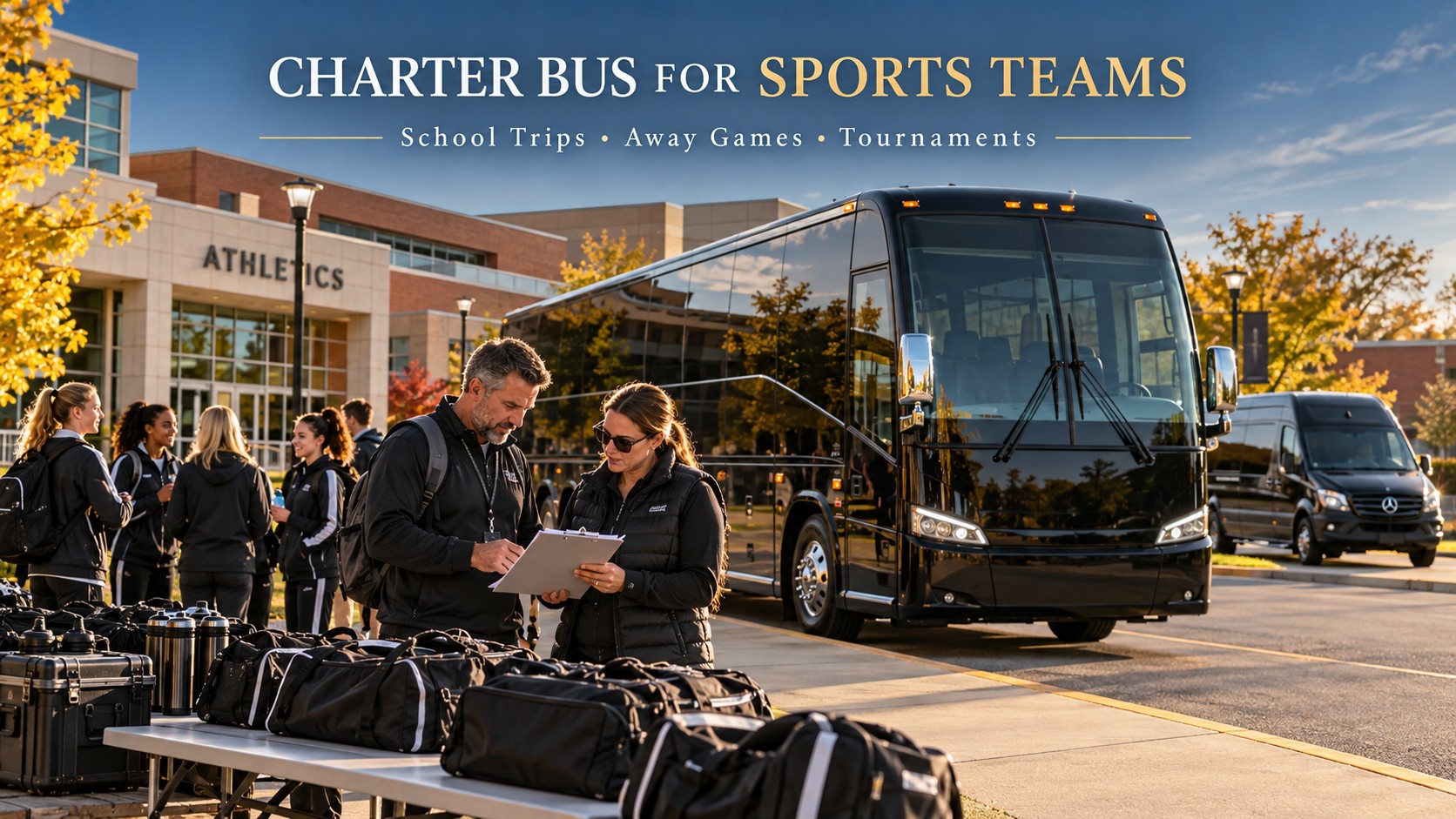
A successful bus reservation begins with a real passenger manifest. An away-game group may include players, assistant coaches, a trainer, an administrator, and approved chaperones. A field trip may include teachers, aides and students with accessibility needs. Separate confirmed travelers from those still awaiting permission; never assume the advertised capacity leaves seats for last-minute additions.
Write down the departure address, arrival venue, any intermediate stops, event schedule, meal arrangements, and return destination. When a tournament includes several games, clarify whether the vehicle stays with the team or returns later. If two teams share one trip, describe their separate start times and whether both groups must be at the venue simultaneously. An itinerary should reflect the real day, not simply fit a quote form. For any charter bus for sports teams, include the earliest required arrival, likely finish, and equipment inventory.
Rock Limo’s group transportation and shuttle coordination service is relevant when several pickups, classes, or teams must move together. The organizer should still designate one person to approve changes and communicate with the assigned carrier. The coach may control the game schedule, but a district transportation administrator may be the only person authorized to approve a route change. Clarify those responsibilities before departure.
Create one master passenger list
Keep a working manifest with traveler totals, emergency contacts maintained under school policy, chaperone assignments, and the correct parent or guardian permissions. Sensitive student information should not be circulated freely in a public team chat. The driver needs the operational information necessary for the trip; the school or organization should manage medical or personal records according to its own policies.
For pickup, arrange a visible gathering point on permitted property.
Plan the end of the day just as carefully
Return trips frequently become more complicated than the morning departure. A game can go into overtime, awards may run late, a teacher may need additional time at the museum, and students can become separated during a large event. Establish the default return time, who can request an extension, what the carrier must approve, and how families will learn about a material schedule change. Do not promise open-ended vehicle waiting or unlimited extra stops.
School Trips, Athletic Tournaments, and Club Travel Are Not Identical
A field trip operated for a district, a school-sanctioned away game, a university sports event, and an independent youth travel-club tournament are different organizational settings. The trip sponsor should identify which entity is contracting for transportation and which laws, school policies, and insurance requirements apply. It is particularly important not to assume that a private youth club automatically falls under every rule applicable to a school district—or that hiring a private charter exempts a school from its responsibilities.
For a class visiting a science center or historical site, the teacher often needs a passenger roster, adult-to-student supervision plan, departure and admission windows, and a designated area for lunch. A tournament team may have a changing game bracket and large equipment bags. A marching band may bring fragile instruments that require carefully planned storage. Every group can use a similar booking checklist, but each itinerary must reflect its specific risks and logistics.
Field trips and educational visits
Confirm the destination’s student entrance and the time groups may check in. Museums and educational attractions may have separate procedures for buses, reserved group entry, lunches, or accessible loading. A venue’s general street address does not establish its motor-coach unloading rules. Obtain current instructions directly from the attraction and share them with dispatch well before the travel date.
High-school and middle-school athletics
Away games and tournaments add uniforms, equipment, practice schedules, changing facilities, and possible late returns. Confirm whether players will dress before departure or need access to changing rooms on arrival. Equipment should be inventoried before selecting a vehicle. If a team brings helmets, pads, coolers, medical kits, or multiple duffel bags, those items need secure, lawful storage rather than loose placement in an aisle.
Rock Limo’s Chicago sporting-event transportation page offers another service context, but a school team’s trip requires institutional approval and appropriate operator review. A fan group’s trip to watch a match is not the same as transporting student athletes under a school’s supervision.
Independent leagues and college groups
Club organizers should verify contracts, permissions, and supervision against the relevant league’s policies.
Charter Bus for Sports Teams Safety and Illinois Driver Requirements
Selecting the actual operating carrier is a core part of responsible trip planning. Rock Limo LLC coordinates charter-bus transportation through a network of licensed affiliate operators; the name on the booking website and the legal company operating the vehicle can differ. Ask the reservations team who will physically provide the bus, and obtain details necessary to verify that company’s relevant authority, insurance, and assigned vehicle. An affiliate arrangement is not inherently a problem; an unexplained operating-company identity is a reason to ask more questions.
Illinois’ Secretary of State describes a Charter Bus Endorsement for drivers of buses other than school buses chartered by a school solely to transport students in grade 12 or below to school-sponsored activities, subject to specific qualifications and exceptions. The State also distinguishes this from school bus permits and endorsements. A school district should check its exact situation with its transportation administrator and the applicable state agency rather than relying on a quick claim that every commercial driver credential is interchangeable.
If the journey involves interstate for-hire passenger transportation under federal jurisdiction, the Federal Motor Carrier Safety Administration provides tools for checking registered operators, applicable passenger authority, insurance filings, and available safety information. For an operator working solely within a state and outside the federal database’s coverage, contact the appropriate state oversight agency. An absent federal safety rating alone should not be presented as proof that an operator is unsafe.
What schools should request
Ask the carrier to explain its verification process for the driver and vehicle assigned to the exact school trip. Depending on the service, a district may require certificates or documentation that its transportation or risk-management staff reviews. The National Transportation Safety Board’s published school-district charter safety checklist encourages verification of operator credentials, available safety records, appropriate seat belts, and a clear pre-trip safety briefing. Schools should use that guidance alongside applicable legal and district requirements, not as a replacement for them.
Useful questions include the carrier’s legal name, applicable identifiers and operating authority, whether the assigned driver’s credentials meet the actual trip requirements, how the provider handles vehicle inspections and breakdowns, and how passengers will receive a safety briefing. A district may also ask what equipment is available for passengers with mobility needs and how that configuration will be documented. Avoid requesting private driver information that the school has no legitimate need to possess.
Safety belts, briefings, and emergency exits
For large motor coaches, restraint equipment varies with vehicle design and model year. The NTSB recommends choosing a vehicle with passenger lap-and-shoulder belts and requiring occupants to wear them properly. The operating carrier should confirm what is installed on the actual assigned unit. Before departure, school leaders should reinforce passenger conduct, emergency procedures, and where to find exits, while the carrier provides the required operational briefing.
Choose the Right Coach and Equipment Configuration
The Rock Limo fleet overview can help a coordinator understand the broad categories available through affiliated operators. Actual seating, storage, restroom availability, accessibility, and other amenities depend on the selected vehicle. Do not treat a representative photograph as a promise of a particular model, seat count, or feature.
For many larger groups, a coach bus rental can accommodate a coordinated itinerary with conventional seating and equipment storage, subject to the vehicle’s confirmed configuration. An organizer may compare the 40-passenger motor coach category with the 56-passenger motor coach category. These published labels are starting points only; verify legal capacity and whether the actual equipment load permits the planned passenger total.
A smaller group might ask whether an executive Sprinter is appropriate, but school transport requirements and vehicle-specific safety rules must be reviewed before choosing that option. A charter bus for sports teams must be assessed for the specific school-sponsored journey; private-group availability alone does not establish suitability for K–12 travel.
Make a sports-equipment inventory
List each item category: duffel bags, large rolling cases, balls, protective gear, musical instruments, team water supplies, and any mobility equipment. Ask the operating carrier where those items will be secured and whether loading can occur safely without blocking aisle space or emergency exits. A bus with enough seats can still be unsuitable for a team carrying a heavy equipment load.
The group vehicle size guide helps compare seating categories. Do not use the published maximum as an automatic passenger allowance when substantial bags or instruments must be accommodated. Confirm the final arrangement in writing, particularly if the assignment involves younger students or specialized equipment.
Timing an Away Game or Tournament Without Guesswork
Build the schedule around fixed responsibilities, then account for loading, traffic and rest requirements. If the team must arrive for a warm-up, uniform change, or check-in, work backward from that time. Include a reasonable buffer developed with the provider rather than stating that a suburban route always takes an exact number of minutes. Congestion around sports venues, school dismissal times, and weather can change travel conditions considerably.
A trip with two pickups should identify who boards at each stop and how late passengers are handled. For multi-team tournaments, list the earliest required arrival and latest likely finish. If the games run on bracket results, describe the possible range of departure times so the carrier can advise whether a standby arrangement or a separate return is feasible.
The Chicago long-distance transportation service is relevant when a tournament extends beyond the metro area. Interstate journeys may introduce additional passenger-carrier and driver-hours considerations that need to be addressed with the operating company. Do not promise an uninterrupted overnight drive or assume that one driver can legally cover an unlimited itinerary.
Keep venue and weather contingencies specific
Ask the host school or athletic venue about approved bus entrances, where vehicles may stage, and when groups are allowed to enter. The correct loading area for a team can differ from the public ticket gate. During winter, include a procedure for cancellations or rescheduled games, and confirm with the carrier how changes to the agreed date affect pricing and vehicle availability.
Airport Arrivals for Visiting Teams and Student Groups
An out-of-state team arriving in Chicago may have more luggage than a normal family flight. Travelers can bring checked sports cases, uniforms, and equipment in addition to individual bags. When requesting pickup, supply flight numbers, passenger counts by flight, the expected total bag inventory, and the final hotel or tournament destination. If several flights arrive at different times or terminals, ask whether one vehicle is practical or whether separate transfers are needed.
Rock Limo’s O’Hare group transportation service can support the discussion of coordinated arrivals. For a smaller group coming through the other airport, review Midway Airport transportation while checking the actual pickup procedure for the assigned commercial vehicle. Motor coaches cannot be assumed to use the same loading lane as passenger cars. The team’s organizer should communicate with dispatch after the travelers regroup, consistent with the confirmed airport instructions.
Build One Communication Plan for Coaches and Families
Reliable group travel depends on coordination as much as the bus itself. Tell families the approved pickup and return points, designated chaperones, and how schedule changes will be communicated. Assign a main adult contact and a backup to work with dispatch.
Keep medical and personal information in the school’s approved systems. Passenger lists for boarding can be managed discreetly without posting student data publicly. Follow your district’s procedures for consent, chaperone ratios, photographs, and emergency notifications; a private transportation company should not be expected to invent or replace those policies.
Costs, Contracts, and Procurement Checks
School and youth group budgets require an accurate comparison, not a speculative per-student number. Price can depend on the date, distance, vehicle category, number of days, scheduled hours, stops, parking, tolls, driver arrangements, equipment needs and operator availability. The Chicago limo and bus pricing guide explains general quote factors, but a published example is not a verified price for an athletic tournament.
Request a written proposal showing the actual operating carrier, vehicle category, full itinerary, included service hours, possible overtime, deposit and payment terms, cancellation rules and applicable additional charges. A district may need the agreement reviewed by procurement, legal, insurance or transportation staff. A booster-club organizer should also confirm who has authority to sign and who will be responsible for changes requested during the trip.
The booking policies guide offers general context for waiting, gratuity, and cancellation questions. Use the terms attached to the actual offer to determine what applies. When a tournament date changes, inform the provider and get any agreed revision in writing.
A school-and-team quote checklist
- Record the school or organization name and the person authorized to approve transportation.
- Identify whether this is a school-sponsored K–12 event, college trip, or independent club journey.
- Provide the full travel dates, pickup addresses, venue instructions and all planned stops.
- Count students, players, coaches, chaperones and other authorized passengers separately.
- List sports equipment, luggage, instruments and accessibility needs before selecting the vehicle.
- Ask for the actual operator and appropriate proof of authority, credentials and insurance.
- Confirm seating, restraint equipment, storage and the operating carrier’s emergency process.
- Review waiting, driver scheduling, overtime, parking, payment and cancellation provisions.
- Document the primary organizer, backup contact and parent communication procedure.
- Keep the written confirmation accessible to the responsible adults on travel day.
Frequently Asked Questions
What information is needed for a school sports-team charter quote?
Provide the date, school or organization, route, all stops, passenger and chaperone counts, equipment inventory, timing, and accessible-vehicle needs. Identify whether the trip is school-sponsored and give the name of the person authorized to approve changes.
Does Illinois have a special endorsement for school-chartered bus drivers?
Illinois describes a Charter Bus Endorsement for applicable drivers of charter buses transporting grade 12 or younger students to school-sponsored activities, subject to rules and exceptions. The district and operating carrier should verify what applies to the specific vehicle and journey.
Are independent youth clubs treated exactly like public schools?
Not automatically. The legal and contractual requirements depend on the operator, vehicle, sponsoring organization, and type of journey. Club leaders should verify applicable rules rather than borrowing a district checklist without confirming its relevance.
Where can a school check a passenger carrier’s safety information?
For companies under federal passenger-carrier oversight, FMCSA offers public carrier search and safety tools. Check the actual operating company’s identity and available records. For wholly intrastate operators outside federal coverage, consult the relevant state agency.
What should a school ask about seat belts?
Ask which restraints are installed on the assigned vehicle and what procedures passengers must follow. The NTSB recommends chartering buses with lap-and-shoulder belts and ensuring they are properly used. Do not assume all bus models have identical equipment.
How should a team estimate bus capacity when bringing gear?
Count people and equipment separately. Sports bags, large cases and mobility devices can reduce practical storage. The operator should confirm legal seating, storage and the exact vehicle, with exits and aisles remaining clear.
Can a team use an executive Sprinter instead of a full-size coach?
It depends on the trip, legal requirements, passenger count, equipment and assigned vehicle. The carrier and school should confirm suitability and required qualifications before selecting a smaller passenger vehicle for a school-sponsored activity.
Can one bus collect players at several schools?
A multi-stop itinerary may be possible if the carrier approves the addresses, loading access, schedule and price. Include each location in the quote and designate one lead person for attendance counts and communication.
What happens if a tournament runs later than scheduled?
Contact the operating carrier through the agreed organizer. Extensions depend on vehicle availability, driver scheduling and the contract’s waiting or overtime terms. Do not assume the original reservation covers unlimited time.
How are out-of-state tournaments different from local trips?
They may involve interstate operating authority, longer driver schedules, overnight stops and additional planning. The carrier and sponsoring organization should verify applicable requirements and book a realistic itinerary rather than promising an uninterrupted journey.
Is a quote request a confirmed charter-bus reservation?
No. Rock Limo’s online request starts a review of the itinerary and availability through its reservation system. The school or organizer must accept the written offer and complete the specified steps before treating the vehicle as reserved.
Who supervises students during a charter-bus trip?
The sponsoring school or organization should assign responsible adult supervisors under its policies. The operating driver is responsible for the vehicle, not for replacing teachers, coaches, or chaperones who manage students and emergency contacts.
About the Rock Limo Service Team
Rock Limo LLC is based in Westmont, Illinois. Established in 2023, its team reports sixteen years of limousine-industry experience and coordinates charter buses, Sprinters and other transportation through licensed operating affiliates. The reservations team can review passenger and equipment needs, proposed itineraries, and available categories, while schools remain responsible for their own approvals and student-supervision policies.
Make the School Trip as Organized as the Event Itself
A charter bus for sports teams can simplify a complex school or club outing when the plan addresses more than seating. The organizer should know who is traveling, what must be transported, when everyone needs to arrive, who is authorized to change the schedule, and which actual carrier will operate the trip. The right equipment and clear documentation matter more than an attractive representative vehicle photograph.
For a school field trip, away game or tournament, request a Rock Limo charter transportation quote with the travel dates, full route, passenger and chaperone counts, equipment inventory and applicable approval requirements. Submitting an online request begins the review; it does not create a confirmed reservation. The team will review availability and provide terms for consideration.
Location: Westmont, Illinois — Official Rock Limo Google Maps Listing
Phone: (708) 990-9233
Email: info@rocklimoservice.com
Contact: Contact Rock Limo Service
Sources & References
- Illinois Secretary of State — Charter Bus Endorsement — School-chartered bus driver qualifications, endorsements, and specified exceptions.
- Illinois State Board of Education — Transportation Programs — State school transportation resources and charter-coach documentation.
- FMCSA — Passenger Carrier Search by Company — Federal registration, available safety information, and insurance verification for covered operators.
- NTSB — School District Checklist: Charter the Safest Vehicles — Carrier vetting, passenger restraints and pre-trip safety briefings.
